Claude Can Now Build an Entire Affiliate Marketing Business for You - 7 Prompts Nobody Is Talking About

The Affiliate Marketing Truth Nobody in the Industry Will Say Out Loud
Affiliate marketing is simultaneously the most overhyped and most underexecuted online income model in existence.
Overhyped because every guru with a YouTube channel has sold you the fantasy version — passive income flowing effortlessly from a blog you built in a weekend, commissions arriving while you sleep, financial freedom achieved by recommending products you barely use to an audience you have not yet built.
Underexecuted because the reality of building an affiliate business that actually generates consistent income requires an amount of systematic, sustained, multi-disciplinary work that the fantasy version never mentions — niche research, competitor analysis, content strategy, SEO optimization, email list building, product selection, conversion optimization, audience trust development, and the relentless content production that feeds all of it.
Most people who attempt affiliate marketing fail not because the model does not work. They fail because the gap between starting and earning is wider than they were told, more work-intensive than they budgeted for, and more skill-dependent than any single person can reasonably cover alone.
Claude just closed that gap.
Not partially. Not for the easy parts. For the entire pipeline — the research, the strategy, the content, the email sequences, the SEO, the product positioning, and the scaling architecture that turns a starting affiliate account into a compounding income machine.
The seven prompts in this article are the operational framework. Each one handles a specific, previously skill-dependent function of affiliate business building. Together they form a complete system that would have taken months to build manually and thousands of dollars to outsource professionally.
Read every one. The last prompt is the one that makes everything else permanent.
Why Affiliate Marketing Is the Right Model for AI Automation — And Why Now

Before the prompts, the mental model that makes everything work.
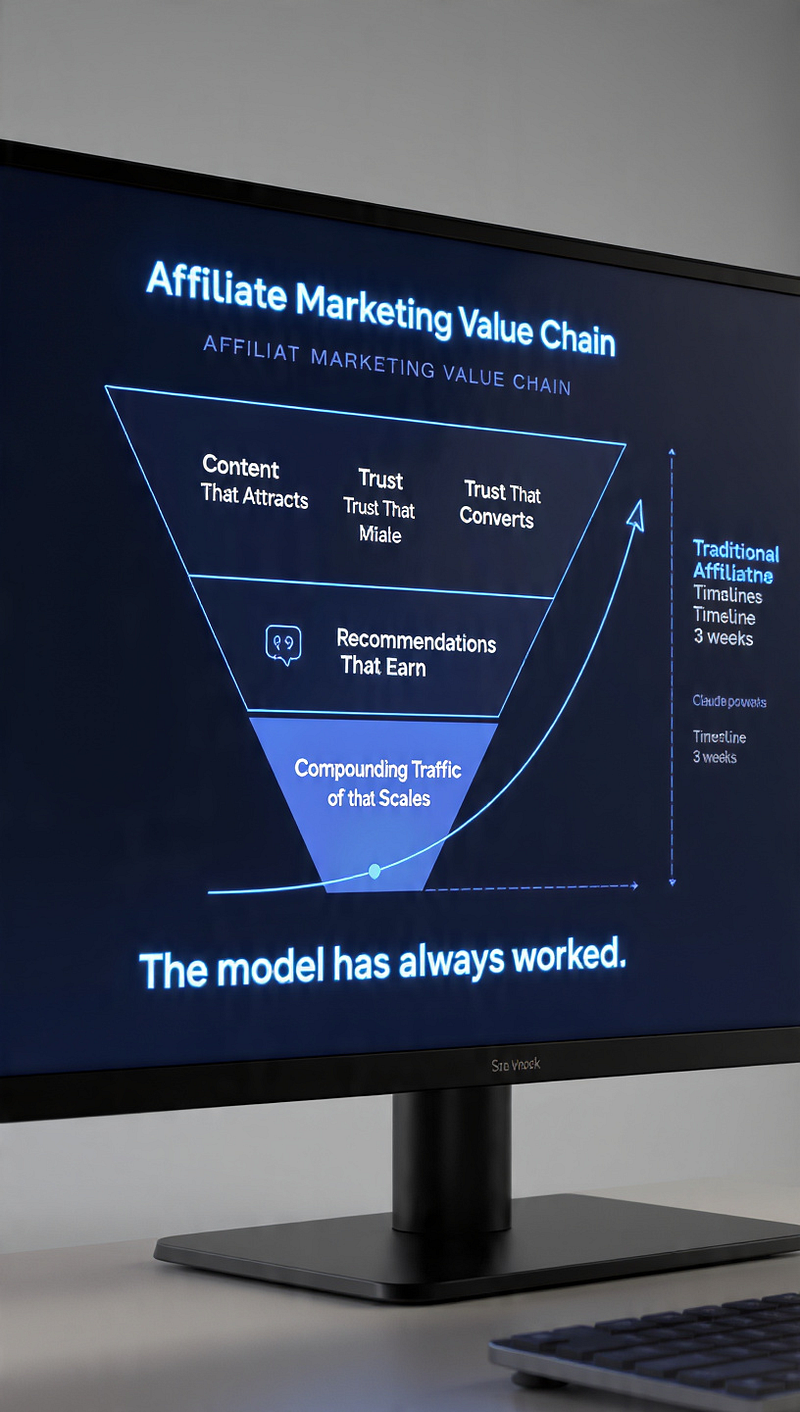
Affiliate marketing is fundamentally a content business. You create content that attracts people searching for information about products and categories. You build trust with that audience through genuinely useful content. You recommend products that solve their specific problems. You earn a commission when they purchase through your link.
The model is simple. The execution requires four distinct competencies operating simultaneously: market research to find profitable niches and products, content creation to attract and educate the audience, SEO to ensure that content is discoverable, and conversion optimization to ensure the traffic you attract actually clicks and buys.
Four competencies. Each one a legitimate specialty. Each one a potential point of failure for a solo operator.
Claude, directed with precision, covers all four — not at the superficial level that generic AI content produces but at the strategic, research-driven, audience-specific level that actually generates commissions.
The seven prompts that follow deploy Claude as your market researcher, your content strategist, your SEO specialist, your email marketer, your conversion optimizer, and your scaling architect — simultaneously, in sequence, building a complete affiliate business from zero.
Prompt #1: The Profitable Niche and Product Selection Intelligence Prompt
What This Replaces: Niche research phase, traditionally 4–6 weeks of manual analysis
The single most expensive mistake in affiliate marketing is entering a niche with insufficient commission potential, excessive competition, or an audience that researches extensively but purchases elsewhere. This mistake cannot be corrected after the fact — it poisons everything built on top of it.
Niche validation before content creation is not optional. This prompt makes it a structured, data-driven, sixty-second exercise.
“You are a senior affiliate marketing strategist with deep expertise in profitable niche identification and affiliate product selection. I am going to give you my interests, background, and available time. Analyze this and produce a complete affiliate niche opportunity report.
For each of the top three niche opportunities you identify, provide: the specific niche with sub-niche focus recommendation, the target audience with psychographic detail beyond basic demographics, the dominant purchase motivation in this niche — what emotional or practical driver causes people to buy, the top five affiliate programs serving this niche with commission rates, cookie durations, average order values, and estimated earnings per click, the content types that perform best in this niche for affiliate conversion, the competitive landscape assessment with an honest evaluation of ranking difficulty for a new site, a traffic potential estimate for a focused content strategy, and a profitability score from 1 to 10 based on commission rates, audience buying intent, competition level, and content production requirements.
My background, interests, and available weekly hours: [INSERT YOUR GENUINE INTERESTS, PROFESSIONAL BACKGROUND, KNOWLEDGE AREAS, AND TIME AVAILABILITY]
Output: ranked niche opportunity report, most profitable and accessible first. Flag any niches where competition makes entry inadvisable for a new affiliate site. Begin immediately with opportunity number one. No preamble.”
Prompt #2: The Affiliate Content Strategy and SEO Architecture Prompt

What This Replaces: SEO content strategist, $2,000-$5,000 per strategy engagement
Content strategy for affiliate marketing is not the same as content strategy for brand awareness or audience building. Every piece of content must be architected around purchase intent — the specific moment in a buyer’s journey where they are evaluating options, seeking validation, or ready to act. Miss the intent and you attract readers who never buy. Hit it consistently and your content becomes a commission-generating asset that compounds in value every month.
“You are an affiliate marketing SEO content strategist specializing in content architectures that rank and convert simultaneously. Based on the niche and products I provide, design a complete six-month content strategy built for affiliate commission generation.
Niche and affiliate products: [INSERT NICHE AND TOP THREE AFFILIATE PRODUCTS FROM PROMPT ONE] Site stage: brand new affiliate site, zero domain authority, zero existing content Content production capacity: [INSERT — e.g., two posts per week / four posts per week]
Produce a complete content architecture including: a keyword strategy framework organized into three content tiers — Tier One: high-intent buyer keywords (best X for Y, X vs Y comparisons, X review), Tier Two: problem-aware informational keywords (how to solve X, why does X happen), Tier Three: audience building keywords (broad educational content that builds topical authority), a six-month content calendar with specific post titles, target keywords, estimated monthly search volume, keyword difficulty rating, content type, and affiliate integration strategy for each piece, an internal linking architecture showing how content clusters connect and channel PageRank toward high-converting pages, a featured snippet targeting strategy for the ten highest-value informational queries in this niche, and a competitor content gap analysis identifying the five highest-opportunity topics currently underserved in this niche.
Output: complete content strategy document formatted as an operational six-month plan. Begin with the keyword strategy framework.”
Prompt #3: The High-Converting Affiliate Content Writing Prompt
What This Replaces: Affiliate content writer, $0.08-$0.25 per word for specialist affiliate copy
This is the prompt that produces the actual content — not generic articles stuffed with keywords and affiliate links but genuinely useful, trust-building, conversion-optimized content that serves the reader while systematically moving them toward a purchase decision.
The difference between affiliate content that converts and affiliate content that does not is specificity, trust signals, and the strategic placement of purchase motivation within genuinely useful information. Claude, directed with this prompt, produces all three.
“You are a specialist affiliate content writer with expertise in creating articles that rank in search engines and convert readers into buyers without feeling salesy or manipulative. Your content serves the reader first and converts as a natural consequence of genuine usefulness.
Write a complete affiliate article for the following specification:
Article title and target keyword: [INSERT FROM YOUR CONTENT CALENDAR] Primary affiliate product to feature: [INSERT PRODUCT NAME, AFFILIATE PROGRAM, AND COMMISSION RATE] Secondary products to mention: [INSERT TWO TO THREE ALTERNATIVE PRODUCTS FOR COMPARISON] Target word count: [INSERT — typically 1,800–3,500 words for affiliate content] Target audience: [INSERT SPECIFIC READER — their situation, what they have already tried, what they are afraid of getting wrong]
Article structure requirements: open with a hook that immediately validates the reader’s search intent and confirms they are in the right place, include a clear table of contents for SEO and user experience, organize the body around the specific questions this audience asks before purchasing, include a genuine pros and cons section for the primary product — do not omit real weaknesses, this builds trust, feature a comparison section where relevant, include real use case scenarios showing exactly who benefits most from the primary recommendation, place affiliate link calls to action at three to four natural conversion points without clustering them, close with a FAQ section targeting People Also Ask keywords for this topic, and end with a clear recommendation summary.
Affiliate integration standard: every product mention must be preceded by a genuine value statement that justifies the recommendation. Never recommend a product solely because it pays the highest commission — this destroys long-term trust and conversion rates.
Begin writing immediately with the article hook.”
Prompt #4: The Email List Building and Affiliate Nurture Sequence Prompt

What This Replaces: Email marketing strategist and copywriter, $1,500-$4,000 per sequence
Affiliate marketers who rely exclusively on search traffic are one algorithm update away from losing their entire income. Email list building is the insurance policy — and more than insurance, it is the highest-converting traffic source available to an affiliate site, consistently outperforming organic search for commission generation when the list is built and nurtured correctly.
“You are an email marketing specialist with deep expertise in affiliate-focused email sequences that build genuine audience relationships and generate consistent commission income.
Design and write a complete email list building and nurture system for an affiliate site in the [INSERT YOUR NICHE] space promoting [INSERT PRIMARY AFFILIATE PRODUCTS].
The system must include:
The Lead Magnet: design a specific lead magnet that attracts the ideal buyer persona for my affiliate products — provide the exact title, a complete outline of the content, and the reason this specific resource will achieve high opt-in rates from this audience.
The Welcome Sequence — seven emails written in full:
Email One: immediate lead magnet delivery plus a personal introduction that establishes credibility and sets expectations for the relationship.
Email Two: the biggest mistake people in this niche make — educational value that demonstrates expertise without selling anything.
Email Three: a genuine product recommendation framed as a resource discovery, not a sales pitch — include the specific language that makes this feel helpful rather than promotional.
Email Four: a case study or transformation story showing a specific outcome achievable with the recommended product.
Email Five: objection handling — address the three most common reasons people in this audience hesitate to purchase the primary affiliate product.
Email Six: a comparison email that honestly evaluates the primary product against the top alternative — this builds trust even when it occasionally loses a commission.
Email Seven: a direct but non-pressured invitation to purchase with a specific reason why now is a good time.
Ongoing nurture calendar: a monthly email content framework maintaining audience engagement and generating consistent affiliate commissions without burning the list.
Tone across all emails: a trusted expert who genuinely wants the reader to make the right decision for their situation — not the highest-commission decision. Begin with the lead magnet design.”
Prompt #5: The Affiliate Product Review and Comparison Page Prompt
What This Replaces: Review content specialist, highest-converting affiliate content type
Product review and comparison pages are the engine of affiliate commission generation. When someone searches “best project management software for freelancers” or “Bluehost vs Siteground” or “is X worth the money,” they are at the highest point of purchase intent in the entire buyer journey. The affiliate who owns that search result owns the commission.
These pages require a specific architecture that balances genuine usefulness with conversion optimization — and Claude builds them with precision.
“You are a specialist affiliate review content writer whose pages consistently rank for high-intent buyer keywords and convert at above-industry-average rates. Your reviews are trusted because they are honest, specific, and written from a position of genuine expertise.
Write a complete affiliate review page for: [INSERT PRODUCT NAME]
Affiliate program details: [INSERT COMMISSION RATE, COOKIE DURATION, AND AVERAGE ORDER VALUE] Primary target keyword: [INSERT — e.g., ‘[Product Name] review’ or ‘is [Product Name] worth it’] Target audience: [INSERT SPECIFIC READER AND THEIR BUYING SITUATION] Competing products to address: [INSERT TWO TO THREE ALTERNATIVES]
Page structure requirements: open with a verdict summary box — a concise rating, a one-sentence recommendation, and who this product is and is not right for — place this above the fold so readers with low time investment get immediate value, follow with a detailed specifications and features breakdown, write a genuine performance assessment organized around the specific use cases your audience cares about most, include a real limitations section — a review with no negatives is not trusted by modern buyers, write a comparison section against the top two alternatives with an honest recommendation for each scenario, include a pricing analysis that contextualizes the cost relative to alternatives and the value delivered, add a FAQ section targeting the specific questions buyers ask before purchasing this product, close with a final verdict that makes a clear recommendation for a specific type of buyer, and place affiliate calls to action at the verdict summary, after the performance section, after the comparison section, and in the final verdict.
Review standard: write as if you are advising a trusted friend. The reader should finish this review knowing exactly whether to buy, wait, or choose an alternative — and why. Begin with the verdict summary box.”
Prompt #6: The Social Media Affiliate Content and Audience Building Prompt

What This Replaces: Social media manager with affiliate marketing expertise, $1,500-$3,500/month
Relying on a single traffic source is the structural vulnerability that collapses affiliate businesses when algorithms change. A multi-platform social content strategy that drives consistent traffic to affiliate content is the diversification that makes income stable — and Claude builds the entire content system in one session.
“You are a social media strategist specializing in affiliate marketing content that builds audiences and drives consistent traffic to affiliate sites and product recommendations.
Create a complete thirty-day social media content system for an affiliate marketer in the [INSERT YOUR NICHE] space across three platforms: [INSERT YOUR CHOSEN PLATFORMS — e.g., Pinterest, Instagram, YouTube Shorts, TikTok, Twitter/X].
Affiliate focus: [INSERT PRIMARY AFFILIATE PRODUCTS AND NICHE] Current following: [INSERT CURRENT AUDIENCE SIZE ON EACH PLATFORM] Content production capacity: [INSERT HOURS AVAILABLE PER WEEK FOR SOCIAL CONTENT]
For each of the thirty days produce: platform assignment showing which platform this content is optimized for, content format — static image, carousel, short video, long video, or text post, content concept in two sentences, complete caption or script written in full for the specified platform, affiliate integration strategy — how this piece of content connects to affiliate earnings without being overtly promotional, call to action appropriate to the platform and content type, and a content repurposing note showing how this piece can be adapted for the other two platforms with minimal additional effort.
Platform-specific requirements: Pinterest content must be optimized for keyword-rich descriptions and vertical image specifications. Instagram content must use the current algorithm-preferred formats and include relevant hashtag clusters. YouTube Shorts content must hook within the first three seconds and include a clear verbal call to action.
Content architecture requirement: of the thirty pieces, ten should be pure educational value building topical authority, ten should be product-adjacent content that soft-sells through genuine usefulness, and ten should be direct recommendation content with clear affiliate calls to action. Distribute strategically. Begin with day one.”
Prompt #7: The Affiliate Business Scaling and Passive Income Automation Prompt

What This Replaces: Business systems consultant and passive income architect, $3,000-$10,000 engagement
Prompts one through six build an affiliate business. Prompt seven is what transforms that business from something you actively operate into something that generates income whether you are working or not — the automation layer, the compounding content strategy, and the scaling architecture that makes affiliate income genuinely passive over time.
This is the prompt that the first six prompts were building toward.
“You are a digital business systems architect specializing in affiliate marketing automation and passive income scaling. Based on my current affiliate business situation, design a complete scaling architecture that moves this business from active income requiring daily involvement to a systematized passive income operation generating consistent monthly commissions.
My current situation: [INSERT YOUR NICHE, AFFILIATE PRODUCTS, CURRENT MONTHLY TRAFFIC, CURRENT MONTHLY COMMISSIONS, EMAIL LIST SIZE, SOCIAL FOLLOWING, AND WEEKLY HOURS CURRENTLY INVESTED]
Design a complete affiliate business automation system across five phases:
Phase One — Content Automation: identify every content creation and distribution task currently requiring my time, specify the exact Claude prompt or automation tool that handles each task, design a weekly workflow where I spend maximum four hours on content and automation handles the rest, and calculate the monthly content output this system produces versus my current manual output.
Phase Two — SEO Compounding Strategy: design a link building approach appropriate for an affiliate site at my current domain authority level, a content refresh protocol that keeps existing articles ranking as competition intensifies, a topical authority expansion roadmap for the next twelve months, and a featured snippet capture strategy for the twenty highest-value queries in my niche.
Phase Three — Email Monetization Deepening: design an advanced email segmentation strategy that serves different affiliate products to different audience segments based on demonstrated interests, an automated behavioral trigger sequence that sends product recommendations based on specific reader actions, and a seasonal affiliate promotion calendar that capitalizes on peak buying periods in my niche.
Phase Four — Revenue Diversification: identify two to three complementary affiliate programs I should add to my current mix based on my existing audience and content, design a digital product opportunity that could be layered on top of my affiliate income using my existing content and audience, and specify the highest-leverage partnerships or collaborations available in my niche.
Phase Five — The $10,000 Month Blueprint: given my specific current situation, produce a precise monthly traffic target, commission per visitor benchmark, email list size milestone, and content volume requirement to reach $10,000 in monthly affiliate commissions, a week-by-week twelve-week action plan mapping the specific path from my current state to that milestone, and the three single highest-leverage actions to take in the next seven days.
Output: complete affiliate business scaling blueprint organized by phase. Make every recommendation specific to my actual situation. Be honest about timeline and effort required. Begin with Phase One.”

The Complete Picture — What These Seven Prompts Build Together
Let’s be precise about the business these seven prompts construct.
Prompt one identifies a profitable niche with validated commission potential and selects the affiliate programs worth building around. Prompt two builds a complete six-month SEO content architecture designed to rank and convert simultaneously. Prompt three writes the actual affiliate content at the quality level that builds trust and generates commissions. Prompt four builds the email infrastructure that converts readers into a captive audience you own and monetize repeatedly. Prompt five creates the high-converting review and comparison pages that capture buyers at peak purchase intent. Prompt six builds the social media system that diversifies traffic and compounds audience growth across platforms. Prompt seven automates the entire operation and maps the specific path to $10,000 in monthly commissions.
That is a complete, professional, systematically built affiliate marketing business — researched, created, and scaled by one person with no agency, no expensive course, no outsourced team, and no prior affiliate marketing expertise beyond the willingness to deploy these prompts with genuine specificity.
The affiliate marketing industry spent years making this look complicated enough to require their coaching programs, their masterminds, their done-for-you services, and their monthly membership communities.
Seven prompts just made that entire infrastructure optional.
And if you want the complete prompt engineering system that makes every prompt in this article work at its highest level — 300 high-income prompts, 12 proven online income models, and the 30-day blueprint that takes you from AI user to AI-powered income earner — AI Prompt Engineering for Profit is the foundation this entire system is built on.
The affiliate commissions are real. The model works. The execution gap just closed.
Comments
Post a Comment