Claude Can Now Write and Launch Your Online Course in 24 Hours — Here Are 7 Prompts the Course Creation Industry Doesn’t Want You to See


Built in a day. Selling by sunset


The Course Creation Industry Has a Dirty Secret


The online course industry is worth over $200 billion globally and growing faster than almost any other digital economy sector.

You already knew that. What you probably did not know is the number that the platform companies, the course creation coaches, and the “build your course” program sellers are desperately hoping stays invisible.

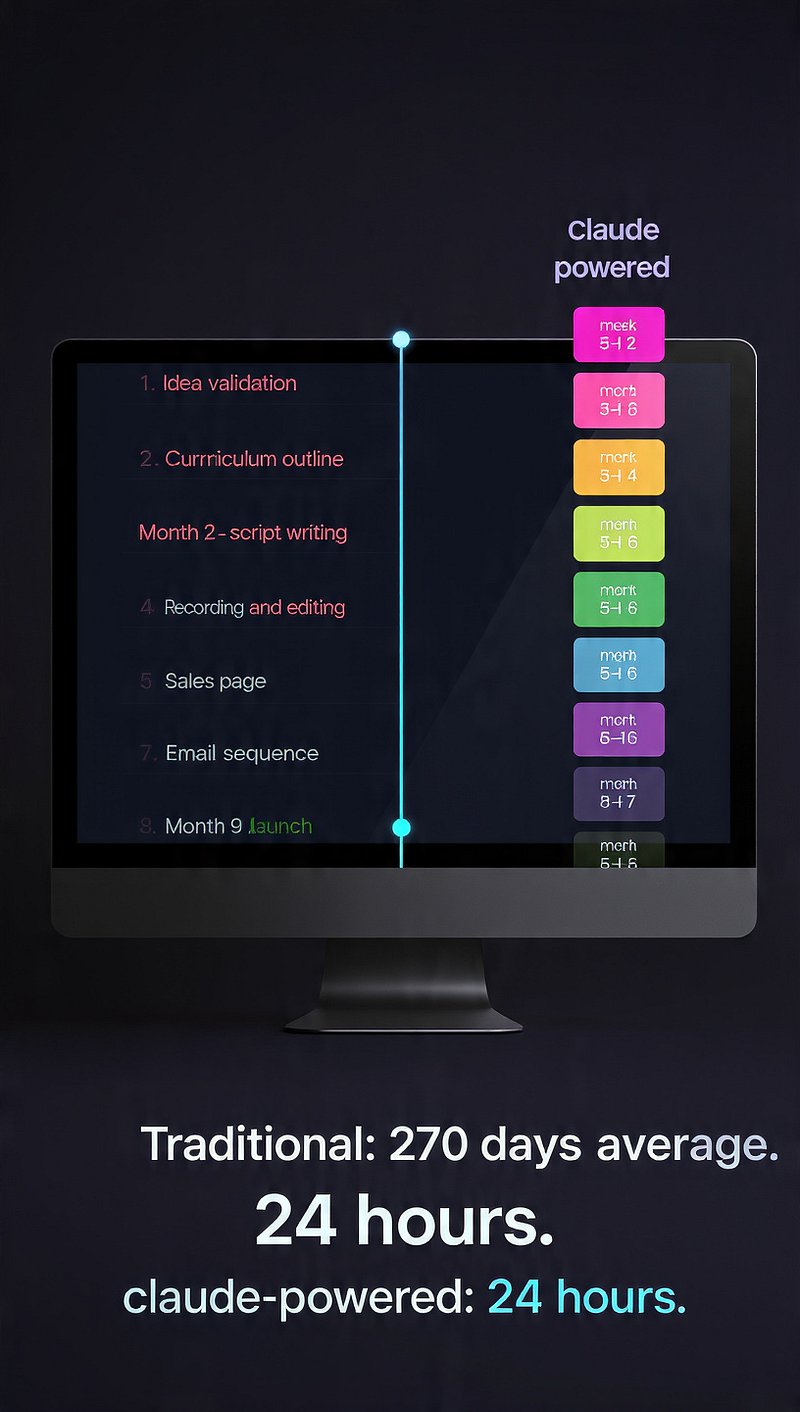
The average time from course idea to published course for a first-time creator following traditional advice is between four and nine months.

Four to nine months of outlining, scripting, recording, editing, building sales pages, writing email sequences, designing curriculum, pricing, launching, and second-guessing every decision while the course sits unfinished on a hard drive that is quietly judging you.

That timeline is not inevitable. It never was. It was always a function of the tools available — and the tools just changed completely.

Claude can now compress that four-to-nine-month timeline into twenty-four hours.

Not a rough draft. Not an outline with placeholders. A complete, structured, market-validated, sales-ready online course — curriculum written, lessons scripted, sales page copy finished, launch email sequence drafted, and pricing strategy justified — in a single focused day.

The seven prompts in this article are the exact framework that makes this possible. The course creation industry built a business model around the idea that creating a course is hard, slow, and requires their guidance. These prompts make that business model obsolete.

Read every one.


Why 24 Hours Is Now Realistic — And Why Nobody Official Is Telling You This


From 9 months to 24 hours. That’s leverage.


Before the prompts, you need the mental model that makes them work — because without it, you will underuse every prompt in this article.

The reason traditional course creation takes months is not complexity. It is decision fatigue combined with isolation. Every step requires a decision the creator does not feel equipped to make confidently: Is this topic specific enough? Is this curriculum structure logical? Is this price point justified? Is this sales copy persuasive enough? Is this launch sequence correctly timed?

Each unanswered question becomes a bottleneck. Each bottleneck extends the timeline. Each extended timeline increases the probability the course never launches at all.

Claude eliminates decision fatigue by making every decision with you — not by replacing your judgment but by giving your judgment something specific and well-reasoned to respond to rather than a blank page to fill.

The difference between staring at an empty document wondering how to structure your course and reviewing a complete Claude-generated curriculum structure that you refine, adjust, and approve is not a small productivity improvement. It is the difference between a course that launches and a course that does not.

Here are the seven prompts that build the complete pipeline in twenty-four hours.


Prompt #1: The Course Idea Validation and Profitable Positioning Prompt


What This Replaces: Market research phase, traditionally 3–4 weeks

Most courses fail before they are created — not because the content is bad but because the positioning is wrong. The topic is too broad, too saturated, or solving a problem the audience does not feel urgently enough to pay to solve.

Validation is not optional. It is the foundation everything else is built on. This prompt makes it a sixty-second exercise instead of a month-long research project.


“You are a digital course market strategist with deep expertise in profitable online education niches. I am going to give you my background, knowledge, and skills. Analyze this information and produce a complete course positioning report.

For each of the top three course opportunities you identify from my background, provide: the specific course topic with a working title, the target student with psychographic detail, the dominant pain point this course solves using the exact language the audience uses to describe it, the transformation the student experiences from start to finish, the competitive landscape assessment and what gap my course fills, the recommended price point with market justification, and a viability score from 1 to 10 based on audience size, willingness to pay, and competition level.

My background, skills, and knowledge areas: [INSERT YOUR EXPERIENCE, SKILLS, PROFESSION, AND AREAS OF GENUINE EXPERTISE]

Output: ranked opportunity report, most viable first. Begin immediately with opportunity number one. No preamble.”


Prompt #2: The Complete Course Curriculum Architecture Prompt

Turn messy ideas into a clear path


What This Replaces: Curriculum design phase, traditionally 4–6 weeks

A well-architected curriculum is what separates a course that gets completed and generates testimonials from a course that gets refunded and generates chargebacks. The sequence of lessons, the progressive complexity, the balance between theory and implementation — these architectural decisions determine student outcomes, and student outcomes determine your reputation and your revenue.


“You are a curriculum design specialist with expertise in adult learning psychology and online course architecture. Based on the course topic and target audience I provide, design a complete course curriculum that maximizes student completion rates and transformation outcomes.

Course topic: [INSERT VALIDATED COURSE TOPIC FROM PROMPT ONE] Target student: [INSERT TARGET AUDIENCE DETAIL] Core transformation promise: [INSERT THE BEFORE AND AFTER STATE] Course format: [INSERT — self-paced video course / live cohort / text-based / hybrid] Target course length: [INSERT — mini course 1–3 hours / standard 4–8 hours / comprehensive 10+ hours]

Produce: a course title with three variations ranked by perceived value and search discoverability, a compelling course subtitle that communicates the specific transformation, a complete module structure with five to eight modules, for each module provide the module title, a one-paragraph module description, four to six individual lesson titles with a two-sentence description of what each lesson teaches, one practical exercise or implementation task per module that ensures active learning, and one module summary checkpoint.

Additionally provide: a recommended quick win lesson to place early in the course that gives students an immediate result and locks in their commitment, a list of five course bonuses that increase perceived value without significantly increasing creation time, and a course completion certificate criteria.

Output: complete curriculum architecture document formatted for immediate use as a course build plan. Begin with the title variations.”


Prompt #3: The Complete Lesson Script Writing Prompt


What This Replaces: Script writing phase, traditionally 6–10 weeks

This is the prompt that does the heaviest lifting and produces the most disbelief — until you run it and see what comes out.

Writing lesson scripts is the bottleneck that kills more courses than any other single factor. It is time-consuming, cognitively demanding, and deeply susceptible to perfectionism paralysis. Creators spend weeks writing scripts that are never good enough to record, recording lessons that are never edited, and editing lessons that are never published.

Claude, directed with this prompt, writes complete, engaging, pedagogically sound lesson scripts that are ready to read directly to camera.


“You are an expert online course scriptwriter specializing in high-engagement, high-completion video lessons for [INSERT YOUR NICHE] audiences. You write scripts that feel like a knowledgeable friend explaining something they genuinely care about — never academic, never dry, always practical.

Write a complete video lesson script for the following lesson: [INSERT LESSON TITLE FROM YOUR CURRICULUM]

This lesson is part of [INSERT MODULE NAME] in a course called [INSERT COURSE TITLE].

Script specifications: target video length [INSERT — 5 minutes / 8 minutes / 12 minutes / 15 minutes], open with a pattern-interrupt hook that immediately communicates why this lesson matters to the student’s real life, include a clear lesson objective statement in the first sixty seconds, structure the lesson body around three to five key teaching points with a concrete real-world example for each point, include at least one moment of direct student engagement such as a question, a challenge, or a pause-and-reflect prompt, close with a clear summary of the three most important takeaways, and end with a specific implementation assignment the student completes before the next lesson.

Audience context: [INSERT WHO THE STUDENT IS, WHERE THEY ARE STARTING FROM, AND WHAT THEY ARE AFRAID OF]

Tone: [INSERT YOUR DESIRED VOICE — authoritative and direct / warm and encouraging / bold and contrarian / conversational and relatable]

Format the script with: HOOK, OBJECTIVE, TEACHING POINT labels for easy on-camera reference. Include estimated speaking time markers every two minutes. Begin writing the script immediately.”


Prompt #4: The Course Sales Page Copy Prompt


A page that sells while you sleep


What This Replaces: Conversion copywriting, traditionally $1,500-$5,000 per sales page

Your course can be exceptional and still not sell if the sales page does not communicate its value with precision and persuasion. Sales page copywriting is a specialized skill that takes years to develop and thousands of dollars to outsource at a professional level.

This prompt produces conversion-grade sales page copy that speaks directly to your target student’s specific pain, desire, and objection set.


“You are a direct response copywriter specializing in online course sales pages that convert cold and warm traffic into enrolled students. Your copy creates genuine urgency through specificity, not manipulation.

Write a complete sales page for the following course. This page must convert a skeptical visitor who has seen many course promises before and needs to believe this one is genuinely different.

Course details: [INSERT COURSE TITLE, CURRICULUM OVERVIEW, PRICE POINT, AND FORMAT] Target student: [INSERT SPECIFIC AUDIENCE WITH DOMINANT PAIN POINT IN THEIR OWN LANGUAGE] Core transformation: [INSERT THE BEFORE STATE AND AFTER STATE IN SPECIFIC, MEASURABLE TERMS]

Write in full: a headline that names the specific transformation in under twelve words, a subheadline identifying exactly who this is for and what it delivers, a three-paragraph problem section that makes the reader feel completely seen and understood, a solution introduction that positions this course as the missing piece without overpromising, a complete what you will learn section with ten outcome-focused bullet points each beginning with a power verb, a complete curriculum overview section with module titles and one-line module descriptions, an instructor credibility section that establishes authority through specificity rather than credential-listing, a ten-item FAQ section addressing the most common objections and hesitations this specific audience has, three pricing options if applicable with the recommended option clearly highlighted, a bold enrollment call to action with a thirty-day guarantee statement, and three realistic social proof testimonials formatted for maximum credibility.

Copy standard: every sentence earns its place or is cut. Begin with the headline.”


Prompt #5: The Course Launch Email Sequence Prompt


What This Replaces: Email marketing strategy and copywriting, traditionally 2–3 weeks

A course without a launch sequence is a course that relies entirely on organic traffic and hope. The email launch sequence is the engine that converts your existing audience — however small — into your first wave of enrolled students, generates social proof, and creates the momentum that sustains sales beyond launch day.


“You are an email marketing specialist with expertise in online course launch sequences that generate enrollment from small, engaged audiences. You write emails that feel personal, build genuine anticipation, and convert without feeling like a sales barrage.

Write a complete seven-email launch sequence for [INSERT COURSE TITLE] launching to [INSERT YOUR AUDIENCE SIZE AND PLATFORM — eg: 800 Instagram followers, 400 email subscribers, 1,200 LinkedIn connections].

Course details: [INSERT COURSE TOPIC, TARGET STUDENT, PRICE POINT, AND CORE TRANSFORMATION] Launch window: seven days from first email to cart close

Write all seven emails in full:

Email One — The Announcement: sent on launch day, creates excitement and curiosity without revealing the price, ends with a specific reason to watch for tomorrow’s email.

Email Two — The Story: sent day two, shares the personal story or professional experience that makes you the right person to teach this, connects your journey directly to the student’s current struggle.

Email Three — The Curriculum Deep Dive: sent day three, walks through what the student will learn in specific outcome-focused language, addresses the ‘is this right for me’ question directly.

Email Four — The Objection Crusher: sent day four, tackles the three biggest reasons someone in this audience would hesitate to enroll, resolves each one with specificity and empathy.

Email Five — Social Proof and Results: sent day five, shares student outcomes if available or specific scenarios describing who gets the best results from this course.

Email Six — The Urgency Email: sent day six, communicates genuine scarcity or deadline with honesty, makes the cost of waiting concrete and specific.

Email Seven — Last Chance: sent on cart close day, final enrollment reminder with a clear deadline, ends with what happens after the cart closes.

Tone across all seven: the voice of a trusted expert who genuinely wants the reader to succeed and is confident this course delivers. No hype. No false urgency. Specific and human throughout. Write all seven emails in full. Begin with Email One.”


Prompt #6: The Course Pricing and Offer Stack Optimization Prompt


Make the middle tier the no-brainer.


What This Replaces: Pricing strategy consultation, traditionally $500-$1,500

Pricing is where most course creators leave the most money on the table. Underpricing devalues the course and attracts the wrong students. Overpricing without the right offer stack kills conversions. The optimal pricing architecture for any course is a function of audience, transformation depth, competitive landscape, and offer construction — variables that Claude can analyze and optimize with precision.


“You are a digital product pricing strategist specializing in online courses and knowledge products. Based on the course details I provide, design a complete pricing and offer stack architecture that maximizes both conversion rate and revenue per student.

Course details: [INSERT COURSE TITLE, CURRICULUM OVERVIEW, TARGET STUDENT, AND CORE TRANSFORMATION] My audience context: [INSERT AUDIENCE SIZE, PLATFORM, AND RELATIONSHIP WARMTH — cold traffic vs warm followers] Competitive landscape: [INSERT ANY SIMILAR COURSES YOU ARE AWARE OF AND THEIR PRICE POINTS]

Produce: a recommended three-tier pricing architecture with specific price points for each tier and explicit reasoning for each price decision, a complete offer stack for each tier detailing exactly what is included and the perceived value of each component, a bonus architecture of five to seven bonuses with individual perceived value assessments and creation complexity ratings, a launch pricing strategy including whether to use an early bird discount, payment plan options with recommended terms, a money-back guarantee structure that reduces purchase anxiety without attracting refund abuse, and a price anchoring strategy for the sales page that makes the core offer price feel like the obvious decision.

Additionally: identify the single highest-leverage addition to the offer stack that would allow a 30% price increase without resistance, and flag any elements of the current course concept that are underdelivering on value relative to the target price point.

Output: complete pricing and offer architecture document with explicit strategic reasoning for every recommendation. Begin with the three-tier pricing structure.”


Prompt #7: The Complete Course Launch and Long-Term Sales System Prompt


Caption:“Automate the work. Keep the profit.”


What This Replaces: Business systems consultant and long-term marketing strategist, $3,000-$8,000

Prompts one through six build a course and launch it. Prompt seven is what separates a one-time launch event from a long-term course business — the automated system that keeps generating enrollments, testimonials, and revenue long after launch day excitement fades.

This is the prompt that makes everything before it compound.


“You are a digital course business systems architect specializing in evergreen course sales and automated enrollment systems. Based on my course and current situation, design a complete long-term course sales architecture that generates consistent monthly enrollment without requiring a new launch every time.

My current situation: [INSERT COURSE TITLE, PRICE POINT, LAUNCH RESULTS IF ANY, CURRENT AUDIENCE SIZE AND PLATFORM, AND TIME AVAILABLE PER WEEK FOR ONGOING MARKETING]

Design a complete evergreen sales system including:

The Automated Traffic System: a content multiplication strategy that takes one piece of weekly content and systematically repurposes it across Instagram, LinkedIn, and one additional platform of your recommendation — include the specific Claude prompts for each repurposing workflow so this process takes under thirty minutes per week.

The Evergreen Funnel Architecture: a complete automated enrollment funnel from first contact to enrolled student — specify the lead magnet that attracts the ideal student, the email welcome sequence that builds trust and sells the course on autopilot, the minimum viable funnel technology stack using only free or low-cost tools, and the conversion benchmarks to track at each funnel stage.

The Testimonial and Social Proof Engine: a systematic process for collecting, formatting, and deploying student testimonials that continuously improve conversion rates — include the exact email templates for requesting testimonials and the strategic placement of each testimonial type across the sales system.

The Course Update and Freshness Protocol: a quarterly course review process that keeps the content current, improves student outcomes, and justifies price increases over time.

The $10,000 Month Roadmap: given my current course price and situation, produce a specific enrollment volume target, a week-by-week twelve-week action plan to reach consistent $10,000 monthly course revenue, and the three highest-leverage actions to take in the first seven days.

Output: complete evergreen course business blueprint organized by system. Make every recommendation specific, executable, and honest about the work required. Begin with the automated traffic system.”


What You Have Just Built


Let’s be precise about what these seven prompts collectively produce in twenty-four hours.

Prompt one validates your course idea and positions it for maximum market appeal. Prompt two builds a complete curriculum architecture that learning science would approve. Prompt three writes your lesson scripts ready for recording. Prompt four produces a conversion-grade sales page. Prompt five delivers a complete seven-email launch sequence. Prompt six optimizes your pricing and offer stack for maximum revenue. Prompt seven builds the evergreen system that generates enrollments indefinitely after launch.

That is a complete, professional, market-ready online course business — built in one day, by one person, with no agency, no course coach, and no $5,000 program teaching you how to do what you just did for free.

The course creation industry built a lucrative business around the idea that creating and launching a course is a long, complicated, expertise-dependent process that requires their guidance and their platforms and their communities and their coaching programs.

These seven prompts make that narrative impossible to sustain.

And if you want the complete prompt engineering system that powers every prompt in this article — 300 high-income prompts across digital products, content creation, marketing, and online income generation, plus the 30-day blueprint for turning AI prompt mastery into a real scalable business — AI Prompt Engineering for Profit is the foundation everything here is built on.

The course creation industry spent years telling you this was hard.

It just got a lot easier.

Your course. Twenty-four hours. Seven prompts.

The only thing left is to start.


Comments